Showing posts with label Biblical Integrity. Show all posts

Thursday, February 5, 2009

Responding to Eastern Orthodoxy being Misrepresented & a Personal Attack against Carthage 397

I was considering posting on the consequences of ignoring Revelation 22:19 when I ran into something that REALLY OFFENDED me in another blog. I am SO OFFENDED that if that person ever posts here, I won't accept any of his posts unless or until he posts an appology and corrects his errors. This guy's bucking for an Anathema! His EXCREMENT is so bad that it shook my Cuss-O-Meter! [Fortunately, my Cuss-O-Meter still remains frozen at Absolute Zero.] I won't disgrace him any further than he has disgraced himself already by calling him out directly (though his initials are CMP), but I will quote him exactly:

3. Paleo-Orthodoxy. This is the belief that the Christian faith can be found in the early church—namely in the consensual beliefs of the early church. This is a form of “consensual orthodoxy” (consensus fidelium).
. . .

Primary Adherents:
Eastern Orthodoxy, some Evangelicals, and many Emerging Christians (not Emergent as I have defined it in my writings)


Strengths:

  • Looks to the historic body of Christ for orthodoxy.
  • Understands that God’s providential concern for the Church would have established the most important truths early.

I'll accept this provisionally.


Weaknesses:

  • Can elevate the authority of the early church above that of Scripture.

Before the Council of Carthage 0f 397 AD, there was no Bible, only scattered fragments of Scripture. These fragments had to be cobbled together into a Cannon. This short-sighted comment ignores the very legitimacy of the Church Council that selected which books went into the New Testament. Denying this Authority only LEGITIMIZES the Gnostic Gospels!

  • Hard to find justifiable reasons to believe that theology cannot develop or mature beyond the first five centuries.

This is the part that makes me sizzle!!! He's obviously never heard of St. Photius or St. Herman of Alaska, or in recent times, Francis Schaeffer, Jack Sparks, or Robert Royster. Timothy Ware's whole 330 page book - The Orthodox Church - is about how Orthodox Theology developed and matured to the current day. Only 30 pages of this 330 page book were devoted to the Church before the Fifth Century. Our "illustrious" scholar might also want to read These Truths We Hold from St. Tikhon's Seminary Press.

He compounds the INSULT with:

Eastern Church: Here, I primarily mean the Eastern Orthodox church. Notice that they are also orthodox. The further developments represented by the “TH” show the progress and maturing of certain doctrines (e.g. person of Christ and the Trinity). The lower case show an undeveloped doctrine (e.g. salvation) and the italics show a distorted understanding (e.g. atonement).

He's obviously never heard of the Nicene Creed. One look at Anthony Coniaris'es Orthodoxy: A Creed for Today, should put that Obvious Falsehood to rest. There is no better place to learn about the Trinity than through the Nicene Creed.

He doesn't stop there. In a section entitled Words That Don't Prove Your Point, he states:

  • If this isn't true, then there is no basis to believe the Bible. If there's no basis to believe the Bible then we might as well be atheists.

This argument also shows up a different way. For example: God can't do that--if He did it would make him the author of Evil and I can't believe in that sort of God. Okay, that's a fine opinion but it doesn't disprove or prove any argument. The latter is a matter of wishing something was true and the former is a matter of setting up a very steep slope with your doctrine at the very tippity top. In both cases it doesn't make your position right or wrong: it's just a non-decider.

Just what was the Council of Carthage of 397 actually doing? Were they wishing that certain Books that they accepted into the Cannon were True, or were they Holier than the Gnostics? In either case, our Esteemed Scholar has just managed to Invalidate the Bible!

My problem with his "Theology" is that with this attack on the Council of Carthage, the Bible actually does go out the Window! Perhaps he's upset that his favorite gospel, The Gospel according to Judas Iscariot, was excluded? It's clear that I'm not going to blog with his group, as his so-called Cannons of Conduct, which excludes honest discussion of the issues I pose, are hypocritically biased towards Calvinism under color of Objectivity.

Friday, December 26, 2008

Edited-Not Translated - Part 2

The verse in question for today for which I shall compare Scripture withScriputre is I Timothy 2:3&4. From Part One of Edited, Not Translated, we have established a formulaic format. First, the jpg of the 1599 Geneva Study Bible, showing the footnote that replaces the verse deletion:


Now for the other versions. First, the Protestant Versions:

New International Version (NIV)

3 This is good, and pleases God our Savior, 4 who wants all men to be saved and to come to a knowledge of the truth.

21st Century King James Version


3 For this is good and acceptable in the sight of God our Savior, 4 who will have all men to be saved and to come unto the knowledge of the truth.

Darby Translation


3 for this is good and acceptable before our Saviour God, 4 who desires that all men should be saved and come to [the] knowledge of [the] truth.

Wycliffe New Testament (WYC)

3 For this thing is good and accepted before God, our Saviour,
4 that will that all men be made safe, and that they come to the knowing of truth. [that will all men to be made safe, and to come to the knowing of truth.]


Next, the Roman Catholics:

The New Jerusalem Bible


3 To do this is right, and acceptable to God our Saviour: 4 he wants everyone to be saved and reach full knowledge of the truth.

And finally, the Orthodox EOB, page 444 :

There was no good way to clip just verse 3 & 4 out, so verses 1 & 2 are included for good measure.

In another blog, the issue was raised that God's Foreknowlege would predetermine the outcome of a Man's Eternal Destiny, and that there was nothing a Man gould do once God had foreseen it. The argument goes that Man cannot go against God's Wishes, as expressed by God's Foreknowlege. Yet, 1 Timothy 2:4 expresses what God's Wishes actually are, which must be dealt with as an accomplished fact. While God's Sovriegnty entails the ability to enforce his Wishes, it also entails the ability to not enforce them, letting the chips fall where they will. Paradoxically, Man's Free Will must be maintained, not in spite of God's Sovriegnty but because of it!

AN example of Foreknowledge not being Sovriegnty can be seen in the example of George Wahington. George Washington, probably the one of the best Weather Forecasters of his age because of what his Military Training entailed, knew what the Weather would be like when he crossed the Delaware on Christmas of 1776 en route to the surprise attack that became the Battle of Trenton. He did not control the Weather, but he had Foreknowlege of it and took advantage of it. He won the battle because of it. However, George Washington did not PREDESTINE anything! Foreknowlege did not make George Washinton God or embue him with any Sovriegnty or anything else, but it only contributed to his victory which could have been spoiled had the Hessians somehow knew to be on their toes for Washington's attack.

1 Timothy 2:4 is an important verse that express God's Will, settling once and for all the supposed Predestination-Foreknowlege Paradox. Like Revelation 22:19, this deletion is too significant an omission in the 1599 Geneva Study Bible because of Doctrinnal Consequences. This is tantamont to overturning established evidence, EDITING, NOT TRANSLATING the Bible.

I wish to convey my special thanks to Billy Birch whose critical inspiration for this post made this post possible.

Monday, December 22, 2008

St. Luke the Iconographer vs. the JWs

Everyone, at one time or another has had a visit form Jehovah's Witnesses. They are infamous for their hardheaded argumentative tactics. If I am in a hurry, I shoo them off. If I have the time and am in the mood, I take the initiative and make a pre-emptive strike. I call it the St. Luke argument. I have ran off JWs with this one. They leave skid marks!


According to Jehovah Witness Theology, from their own website: ". . . warnings regarding the use of idols are common in the Christian Greek Scriptures, also called the New Testament." . . . "pagan worship of pictures was replaced by the veneration of pictures of Jesus, Mary, angels, and “saints.” These pictures that started to be used in the churches gradually found their way into the homes of millions of people, being venerated there as well." Clearly, Jehovah's Witnesses equate icons to idolatry. Enter St. Luke, the Iconographer. As you an see from his icon, St. Luke has been caught red-handed in the act of making icons! There is no denying it! St. Luke must be roasting in Hades for his terrible sin! According to Jehovah's Witness Theology, St. Luke has been caught in the act of Gross Idolarty! St. Luke is even worse than Judas Iscariot! Oh, the Shame of it all! How can a Jehovah's Witness, in good conscience, allow the Gospel of that Wicked Idoater become part of the New Testament! . . . and yet, the Gospel of St. Luke is still part of the Jehovah Witness Bible.

Do not attempt to repel Catholics or even Methodists with this argument, especially if you have a respectable collection of Icons. Their typical response would doubtless be "Iconography is not Idolatry, or even a sin in my Religion. St. Luke's Gospel STAYS in MY BIBLE. If you have any Icons you want rid of, just give them to me." Seriously, I've had fun watching the JWs scatter with this. I found the Icon Test a good one for separating Wheat from Chaff.

Thursday, December 18, 2008

Kurt Gödel and Paradoxes

Albert Einstein with Kurt Gödel
Mathematician Kurt Gödel is famous for his investigations into paradoxes, and was also a noted philosopher. His methodology of producing paradoxes are a keystone to this blog. Gödel was so caught up in paradoxes that he almost blew his US Citizenship over his finding that the US Constitution had an inconsistency. He was fortunate that his friends Albert Einstein and Oskar Morgenstern, who invited themselves as witnesses and handlers, were able to defuse the situation, with the judicious steering of Justice Phillip Foreman.

According to the wiki: he proved for any computable axiomatic system that is powerful enough to describe the arithmetic of the natural numbers (e.g. the Peano axioms or ZFC), that:

  1. If the
system is consistent, it cannot be complete. (This is generally known as the incompleteness theorem.)
  • The consistency of the axioms cannot be proved within the system.

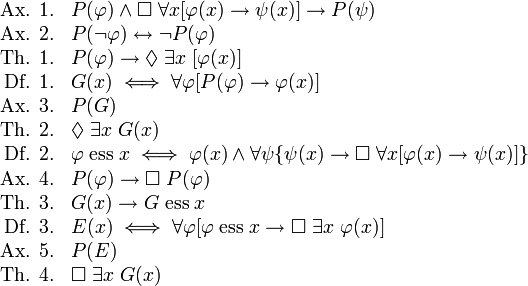
  • Gödel is also known for his Ontological Proof of the Existence of God. His methodology is also responsible for the disproof of God's Existence that "God cannot create a rock too large for him to lift." Here, mostly for decoration but partly for the curious, is Gödel's Proof of the Existence of God:


    Paradoxes derive from self-referentiality. A statement that refers to itself creates paradoxes abot itself. For example, "This statement is False." is neither a True or a False statement, especially because it is self-contradictory. Likewise, "This statement is True" is both True and False.

    Theologically speaking, it can be argued that God is the most self-referential object in the Universe, making Him the most paradoxical object in the Universe. How many times have you read in the Bible that God is beyond Human Understanding? This certainly hints at Gödel's Proof.

    This brings me to this blog's purpose. The question I continually ask is "What must be True for Biblical Integrity." I take a doctrine, say Predestination, and compare it to my Question of Biblical Integrity, amd if I get a Paradox, I question that Paradox. This reasoning is of necessity, Deductive Reasoning, It generally has to be devoid of Hermeneutics because Hermeneutics is based upon Inductive Reasoning, and Hermeneutic methods introduce extraneous paradoxes by introducing unnecessary self-referentially to the Scriptures.

    Here's where Faith comes in. I am counting upon the Scriptures to be consistant. However, because "The consistency of the axioms cannot be proven within the system", I have to discard Sola Scriptura. That Proof From Without comes that collection of writings called Tradition (i.e., commentaries by early Saints and Scholars, Church Councils, Histories, and early Training Manuals). From the Orthodox Point of View, the Scriptures were a special part of Tradition that was elevated by Church Council to be the Bible. This means that if there are inconsistancies, they will occur within Tradition. [OK, this paragraph may still have a few inconsistencies. I'll probably have to spend a lifetime to get it right only to discover that this is an impossibility, but at least I have written a rough draft of what I meant to say. Gödel must be having lots of fun in Heaven watching me struggle with this.]

    Wednesday, December 17, 2008

    The Language of this Blog - The Sacred and The Profane

    You may have noticed two gadgets on the right side of this blog, the Cuss-O-Meter and the Intelligence Meter. I have a Cuss-O-Meter Rating of Absolute Zero and a Genius Rating for my blog, both ratings I intend to keep.

    I have been accused of ingorance because I do not use the Language of Calvinism, which I call Calvin's Cant. I do not usually use the words Mongerism, Prevenient, Reprobation, Supralapsarianism, or other words in the dictionary of Calvin's Cant. Granted, I could guarantee my Genius Rating by using these long words, but it there isn't sufficient cause to do so. To tell the Truth, it would be easier for me to cuss on this blog than to use Calvin's Cant, hence my use of the Cuss-O-Meter. I am certainly capable of understanding Calvin's Cant, just as I understand Profanity; however, neither is part of my Normal Vocabulary. Using Profanity makes me feel unclean, but using Calvin's Cant makes me feel even worse.

    You may have noticed that my positions are extremely critical of Calvinsm, yet though I am among the Arminians, my arguments are not Armenian arguments. This is because I am outside both Arminian and Calvinist Religious Traditions. I do not take the Middle Ground between Arminianism and Calvinism, but rather consider Arminianism to be the Middle Ground between myself and the Calvinists. I am not even a Protestant, though I started life as a Protestant. Then I grew up. My earliest years were spent debating the issues of Free Will and Predestination. Then Desiridus Erasmus came my way. As my thoughts turned elsewhere, the following Erasmus quote became more relavant:

    . . . philosophers in their long beards and short cloaks, who esteem themselves the only favourites of wisdom, and look upon the rest of mankind as the dirt and rubbish of the creation: yet these men’s happiness is only a frantic craziness of brain; they build castles in the air, and infinite worlds in a vacuum.

    As I grew, I became Eastern Orthodox by degrees, where I learned that I was partaking in the wrong debates altogether. Granted, Arminians were usually my allies, but it was only because John Wesley heavily borrowed Eastern Orthodox arguments to debate the Calvinists. Eastern Orthodoxy is a Major Branch of Christianity; wheras, Calvinism is but a splinter group in a different Branch of Christianity.

    It would also be a mistake to consider me an Arminian. I do not draw my lines down Arminian versus Calvinist lines. I draw them down Orthodox versus Gnostic lines. Though the Gnostics are officially defunct, there are plenty of Neo-Gnostics about. My problem is that the Calvinists are making the very compromises that legitimize the Neo-Gnostics. The line I draw puts most of the Arminians on my side of the line, at least nominally. While the line is not necessarily coincident with the line between Calvinism and Arminianism, it certainly goes through the Calvinist Camp, probably somewhere near the line between Calvinism and HyperCalvinism.

    Once this is understood, the Issues of the Consequences of Biblical Integrity, you will be more attuned to this blog. Calvinism makes too many sacrifices of the Integrity of the Bible, and gets the brunt of my pen's wrath; however, I find that Arminians are often lukewarm on this issue, although far more receptive.

    Back to my point about Profanity and Calvin's Cant, I find that the language you use, as well as the language you don't use, reflects those who use it. That's why I avoid both Vocabularies, even though I can use both, and often interchangeably. In fact, if anyone complains on this blog that I don't understand Hermeneutics, I plan to reciprocate by visiting said person's blog and complain that they don't understand Profanity, possibly giving some examples. I'll not be judged as Duns Scotus was, for the excessive dichotomization and superfluous discoursing for which he earned his Crown, the Dunce Cap.

    Tuesday, December 16, 2008

    Chapter XXXI of The Westminster Confession: A Trojan Horse

    Firstly, I wish to convey my Eternal Gratitude to Matt for giving the most damaging argument against, and the Final Nail in the Coffin of, Article XXXI of the Westminster Confession, the Doctrine of Illumination! While I was merely intending to debunk it, Illuminaton has given me the means to Totally Anihilate it! Thanks, Matt!!!

    When I first read about Calvin's Institutions, I first thought he meant the most basic of all Church Institutions, the Church Council. Searching intently, I was gravely dissapointed. What I found was contained in Chapter XXXI of the Westminster Confession in Chapter IV :

    IV. All synods or councils since the apostles' times, whether general or particular, may err, and many have erred; therefore they are not to be made the rule of faith or practice, but to be used as a help in both.

    What a dissapointment! Further research revealed that John Calvin was actually agiainst the Seven Church Councils, and the Westminster Confession delegitimized them with Chapter XXXI. In fact Chapter XXXI goes even further. ALL Church Councils are invalid because of Sin. Their pronouncements upon doctrine are meaningless. The Nicene Creed, a product of the Councils of Nicea and Chalcedon, has been voided. Other products of other Councils, in partcular Carthage 397 which selected the books of the Bible while discarding the Gnostic Scriptures, are void! Of course, there is also the paradox/logical conclusion that the Westminster Confession and the Council of Dordt are also void because of Chapter XXXI.

    Let us examine the consequences of Chapter XXXI upon the Bible. Carthage 397 is invalid and can be overruled. This means that the Books of the Bible can be reselected from the candidate books, which include the Gnostic Gospels. The Gnostic Gospels, like any other set of scriptures, are self-authenticating. Clearly, Chapter XXXI is a Trojan Horse that permits the suplanting of the current books of the New Testament.

    However, thanks to Matt who reminds us of the Doctrine of Illumination, the Church Fathers were indeed made competant to separate Wheat from Chaff, a point religiously ignored by Chapter XXXI. According to Matt: "God first and continually bestows holiness upon the sinner through justification and sanctification. Illumination is that process whereby the Holy Spirit overcomes the lingering sin of the redeemed so that he can correctly interpret Scripture. ", a point ignored by the Chapter XXXI. Yet he backpeddles with: "I am not claiming that Illumination conveys holiness. The Spirit does that legally in justification and experientially in sanctification." However, I will take Matt's first statement at face value and observe that his first argument effectively restores the Seven Church Councils and the Nicene Creed to their former credibility, no thanks to the Westminster Confession. Thanks again, Matt!

    I would be remiss in my duty if I did not mention what I would replace Article XXXI with. Since it is a Trojan Horse, I would delete it altogether. Since God's Word is Eternal, a Doctrine of Stairs Decisis is what would be called for.