Showing posts with label Paradox. Show all posts

Thursday, December 18, 2008

Kurt Gödel and Paradoxes

Albert Einstein with Kurt Gödel
Mathematician Kurt Gödel is famous for his investigations into paradoxes, and was also a noted philosopher. His methodology of producing paradoxes are a keystone to this blog. Gödel was so caught up in paradoxes that he almost blew his US Citizenship over his finding that the US Constitution had an inconsistency. He was fortunate that his friends Albert Einstein and Oskar Morgenstern, who invited themselves as witnesses and handlers, were able to defuse the situation, with the judicious steering of Justice Phillip Foreman.

According to the wiki: he proved for any computable axiomatic system that is powerful enough to describe the arithmetic of the natural numbers (e.g. the Peano axioms or ZFC), that:

  1. If the
system is consistent, it cannot be complete. (This is generally known as the incompleteness theorem.)
  • The consistency of the axioms cannot be proved within the system.

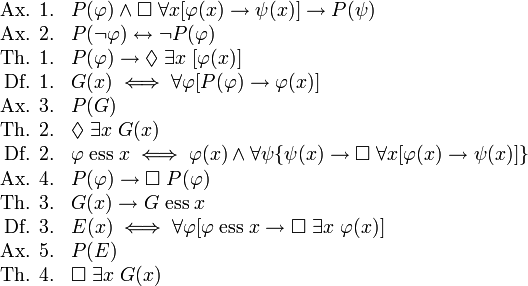
  • Gödel is also known for his Ontological Proof of the Existence of God. His methodology is also responsible for the disproof of God's Existence that "God cannot create a rock too large for him to lift." Here, mostly for decoration but partly for the curious, is Gödel's Proof of the Existence of God:

    Paradoxes derive from self-referentiality. A statement that refers to itself creates paradoxes abot itself. For example, "This statement is False." is neither a True or a False statement, especially because it is self-contradictory. Likewise, "This statement is True" is both True and False.

    Theologically speaking, it can be argued that God is the most self-referential object in the Universe, making Him the most paradoxical object in the Universe. How many times have you read in the Bible that God is beyond Human Understanding? This certainly hints at Gödel's Proof.

    This brings me to this blog's purpose. The question I continually ask is "What must be True for Biblical Integrity." I take a doctrine, say Predestination, and compare it to my Question of Biblical Integrity, amd if I get a Paradox, I question that Paradox. This reasoning is of necessity, Deductive Reasoning, It generally has to be devoid of Hermeneutics because Hermeneutics is based upon Inductive Reasoning, and Hermeneutic methods introduce extraneous paradoxes by introducing unnecessary self-referentially to the Scriptures.

    Here's where Faith comes in. I am counting upon the Scriptures to be consistant. However, because "The consistency of the axioms cannot be proven within the system", I have to discard Sola Scriptura. That Proof From Without comes that collection of writings called Tradition (i.e., commentaries by early Saints and Scholars, Church Councils, Histories, and early Training Manuals). From the Orthodox Point of View, the Scriptures were a special part of Tradition that was elevated by Church Council to be the Bible. This means that if there are inconsistancies, they will occur within Tradition. [OK, this paragraph may still have a few inconsistencies. I'll probably have to spend a lifetime to get it right only to discover that this is an impossibility, but at least I have written a rough draft of what I meant to say. Gödel must be having lots of fun in Heaven watching me struggle with this.]

    Saturday, December 13, 2008

    Doctrinal Paradoxes

    We owe it to Mathematician Kurt Gödel that paradoxes derive from self-referentiality. This causes problems with the belief that the Bible being "self-authenticating". By construct, there are other holy books which must, of necessity, be self-authenticating. Even Mathematical Texts are self-authenticating. Such a weak claim of self-authentication detracts, rather than enhances, the Truth of the Bible. If I am to maintain my Christianity, I can have no use for "self-authentication".

    Let us recognize that there have been several attempts to control the message of the Bible, either by the insertion of false books into the Bible as was tried by the Gnostics in the first three centuries of Christianity tried to do, or by the editing of Biblical content to maintain pet doctrines, such as the editing of the Bible to de-emphasize scripture, say Revelation 22:19 to protect a pet doctrine.

    The main focus, however, is to investigate the underpinnings of if the Bible were true in relation to Doctrine. Case in point are the doctrines of Monergism and Total Depravity. If Mongerism and/or Total Depravity were true, than Man can in no way further the cause of his own salvation, or for that matter, the salvation of another. The translating, publishing, and commentary on the Bible are activities which, if competently done, furthers the salvation of Man. Therefore, the Bible cannot be competently translated, published, or commented upon. Since this is a conclusion that I cannot accept without the abandonment of the Bible or Christianity, I must discard Mongerism and Total Depravity.

    The sieve I use to separate Wheat from Chaff is the Reduction to an Absurdity technique of Mathematicians. This blog's premise is that anything that undermines the Bible, its authority, and the Canonization process, from which the Bible was determined, is void. In consequence, I must oppose various forms of NeoGnosticism or premises that legitimatize NeoGnosticism as certain confessions of faith would do. Said compromises with NeoGnosticism opens the way for the inclusion of previously discarded books from the Bible, in particular, the gospels of Judas, Thomas, and Phillip, and the Apocalypse of St. Peter. Since Cannonization was a MetaScriptural Process, this blog must also be MetaScriptural. When Scripture is actually quoted, it will be generally be used to demonstrate that a particular version of the Bible is Edited, Not Translated in this blog.

    Theological Responsibility requires that if a doctrine gets refuted, it must either be replaced by by a plausibe doctrine, or that it wasn't needed to begin with. To be Theologically Responsible, my refutation of Monergism has made me Synsegistic by default. Since there is Sin in this World, I have to account for it in consequence to debunking Total Depravity. I find both the Doctrine of Original Sin and the Doctrine of the Corruption of the Nature of Man both acceptable doctrines at this point.

    I must make one last observation. There is an obscure "Doctrine of Illumination", apparently propounded by St. Augustine, that God can cause a person to be illumined. Illumination does not confer Holiness. It follows that an Illumined Sinner is still a Totally Depraved Sinner, and the incompetance to translate, copy, print, interpret, or comment upon the Bible still remains. Chapter XXXI of the Westminster Confession, to be discussed later, actually concedes the point by stating that ALL Church Councils are invalid because they are Sinful without imputing ANY Illumination to ANY Church Council.